Home / Products / M3 ruby styli

M3 ruby styli: Ø0.5 to Ø6 mm, carbide and ceramic

The middle thread, and the range that covers most CMM work. Eighteen of the most-used geometries, cataloged, from a Ø0.5 mm ball on a Ø0.4 mm carbide stem for small features to Ø3.0 mm for everyday inspection. The full M3 range runs to Ø6.0 mm and is in the catalog.

M3Thread
Ø0.5–6Ball, mm
18Cataloged geometries
G10 / G5Ruby ball, ISO 3290

Standard M3 range

Codes are the factory part numbers. The last four digits map to the OEM number in the cross-reference column of the full catalog. Testing is quoted per line when you need it: a batch report for the parts you receive, or a per-piece certificate where your incoming inspection requires one.

CodeBallStemLengthEWLTypical use
BV-M3-21T-005R-7632Ø0.5Ø0.4 tungsten carbide212.0Micro features, thread roots
BV-M3-20T-01R-2442Ø1.0Ø0.7 tungsten carbide2012.5Micro features, thread roots
BV-M3-30T-01RØ1.0Ø0.8 tungsten carbide3022.5Micro features, thread roots
BV-M3-40T-01RØ1.0Ø0.8 tungsten carbide4032.5Micro features, thread roots
BV-M3-50T-01RØ1.0Ø0.8 tungsten carbide5042.5Micro features, thread roots
BV-M3-21T-015R-0050Ø1.5Ø1.0 tungsten carbide2012.5Small bores and slots
BV-M3-30T-015R-0051Ø1.5Ø1.0 tungsten carbide3022.5Small bores and slots
BV-M3-20T-02R-3676Ø2.0Ø1.5 tungsten carbide2012.5Small bores and slots
BV-M3-30T-02R-0052Ø2.0Ø1.5 tungsten carbide3022.8Small bores and slots
BV-M3-40T-02R-0053Ø2.0Ø1.5 tungsten carbide4032.5Small bores and slots
BV-M3-40C-02R-3646Ø2.0Ø1.5 ceramic4032.5Small bores and slots
BV-M3-50T-02RØ2.0Ø1.5 tungsten carbide5042.5Small bores and slots
BV-M3-21T-025R-0054Ø2.5Ø1.5 tungsten carbide2012.5Everyday inspection work
BV-M3-30T-025R-0055Ø2.5Ø1.5 tungsten carbide3022.5Everyday inspection work
BV-M3-40T-025R-0056Ø2.5Ø1.5 tungsten carbide4032.5Everyday inspection work
BV-M3-40C-025R-2545Ø2.5Ø2.0 ceramic4032.5Everyday inspection work
BV-M3-20T-03R-7402Ø3.0Ø2.0 tungsten carbide2014.0Everyday inspection work
BV-M3-30T-03R-0057Ø3.0Ø2.0 tungsten carbide3024.0Everyday inspection work

Not on the list? M3 styli are the easiest range to build to drawing: stepped stems, tapered stems, mixed ball sizes, offset and star configurations. Send the drawing and get feasibility in 24 hours.

How to choose within the range

Three decisions, in this order.

  • Ball first. Pick the largest ball that still reaches the feature. Smaller balls measure tighter geometry but amplify surface finish into the result.
  • Then length. Use the shortest stylus that clears the part. Every 20 mm of extra length costs you measurable stiffness.
  • Then stem material. Carbide for minimum diameter, ceramic for crash tolerance and thermal stability, carbon fiber past 100 mm.

Rule of thumb used in most metrology labs: keep the ball diameter at least 3× the surface roughness you need to ignore, and keep the stem diameter at least 1/10 of the overall length.
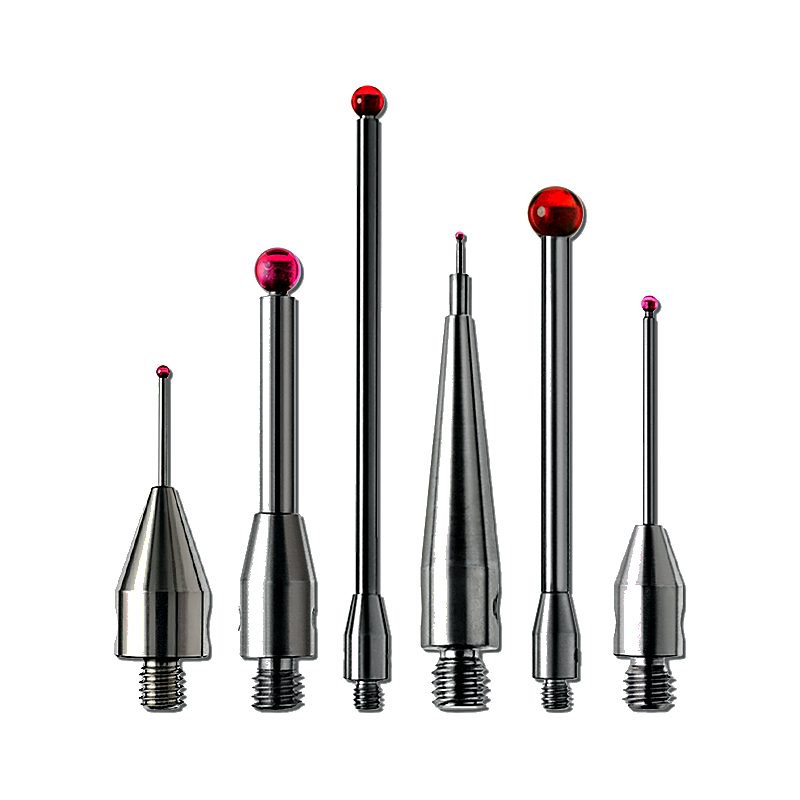
M3 thread ruby ball styli with carbide and ceramic stems in various lengths

Specification, in numbers

ParameterStandardOn request
Ball materialRuby (synthetic corundum)Silicon nitride, zirconia
Ball gradeISO 3290 Grade 10 (standard production)Grade 5, imported balls, on request
Ball diameter tolerance±2 µm±1 µm with imported grade 5 balls
SphericityPer ISO 3290 grade 10 (≈0.25 µm)Per grade 5 (≈0.13 µm)
Ball surface roughnessTypical for ruby (Ra ≤0.012 µm). Not measured unless requested; sphericity governs—
Stem straightnessHeld to the tolerance on your drawingTighter limits quoted on request
ThreadM3, go/no-go gaugedM2, M4, M5, non-standard
ReportBatch report, ISO/IEC 17025 traceable, on requestPer-piece certificate, quoted per piece
Stated toleranceGrade per ISO 3290; when testing is ordered, the measured value of your parts is printed in the reportReport value governs, not this page
MOQ1 pc, evaluation samples includedVolume pricing quoted against your annual usage

M3 stylus questions

Can I use an M3 stylus in an M4 head with an adapter?

Physically yes, metrologically no. An adapter adds a joint, and every joint adds both compliance and a datum you cannot verify. If the head is M4, buy M4 styli.

Do I need to recalibrate after changing a stylus?

Yes. Requalify the stylus after any change, even same part number. The qualification defines the ball center in machine coordinates, and that is what changes, not the stylus.

How many styli does a typical shop use per year?

A single CMM running one shift usually consumes 6–15 styli a year, mostly from crash damage rather than wear. Ruby is hard, but it is not indestructible against a rapid move into a vise.

Tell us the feature. We will tell you the stylus.

Send the drawing, the bore size, or just a photo of the probe head. Answer within 24 hours, with a price and a lead time.

Exported & supported by Dongguan Fancy Home Trading Co., Limited (Hong Kong) · bevyprecision.com